Showing posts with label what is an energy audit. Show all posts

Thursday, July 25, 2013

Why baffles along bird vents in your attic are a good idea

Picture
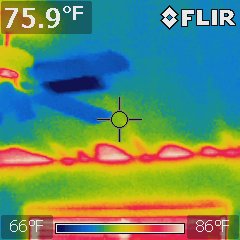
Infrared image from inside along the side of a home where the insulation has been blown back because of lack of baffles placed along the bird vents
If you have two or three bird venting holes along the outside of your roof line these are a great way to ventilate your attic along with gable ventilation on each end of the roof end.

The problem lies in that the builders and insulation contractors or any other contractor for that matter essentially do not talk to each other. That is the cause for hot rooms, poor airflow, unless art heat gain into your home and high utility bills but I digress. The lack of communication and just poor practices or laziness on part of insulation contractors is the reason why baffles or ridge vents are not placed at all the bird vents above the house.

But why are they even needed in the first place? The reason is two-fold.

1. Baffles direct airlflow up the roof slope and out the ridge vents if you have them. If you don't have baffles then the air that vents the attic will blow back the insulation a good foot or more from the sides of the house.

2. Some contractors will put a fiberglass batt in-place of a baffle because the fiberglass batt is rigid and won't blow back. The fiberglass batt insulation will allow airlflow to pass through it (as all loose fill insulation will) but there is a problem with this scenario. The fiberglass batt insulation allows hot outside air to pass through it but it does not direct the airflow up and away from the drywall ceiling. So while the outside air is passing through the batt, it is also heating the drywall which defeats the purpose of the fiberglass batt.

Baffles can be cardboard, plastic or Styrofoam material and come in 16" on center or 24" on center sizes. Expect to pay a little more for baffles especially in a retrofit situation and garages are NOT included in the square footage of your attic or in insulation quotes.

Tuesday, July 23, 2013

Energy efficiency mortgages in Phoenix

This is not a secret and is accessible to any lender, there are standard guidelines through FHA, Fannie Mae and Freddy Mac.

Energy efficiency (EE) is a great selling point.

There is strong consumer demand nationwide, from the National Association of Realators, Time Magazine, and the buyers. Everyone asks about energy efficiency from buyers to tenants. In 2010 apartments.com did a survey have found that 89% preferred a green apartment community and more than 25% would pay higher rent. Green also includes low VOC homes and use of recycled content in buildings.

So how as sellers and contractors do we differentiate ourselves? The answer is energy efficiency. EE homes sell for more and at a higher prices. Homeowners want lower utility bills and EE delivers.

An EE home also means fewer buyer inspections with a HERS report already done which can help close a home quickly.

Seattle, Portland and California have all shown an 8.5 to 12% premium for EE homes.

For buyers you can have the dream kitchen you've always wanted plus energy efficient appliances. Plus Energy efficiency mortgages gives better income ratios which means buyers qualify for higher mortgage amounts. Sometimes the air conditioner will get up and walk away during the middle of the night and an EEM will cover the cost of that built into the mortgage.

Plus there are rebates from APS and SRP... up to $1000 is available to put more insulation, duct and air seal a home and shade screens.

An energy audit should be as important as a home warranty or home inspection for all homes. If a homeowner gets a $500 summer bill their first month in their home is not a pleasant surprise for a new homeowner.

Myths
- a bigger AC is better
- an Energy Efficient Home means a homeowner has to go solar
- underwater homes cannot be refinanced (you can refiance without a new appraisal through a new Energy Efficiency Mortgage)
- buyers cannot qualify (more buying power to make the appraisal work in some cases, the more information the better and can be the tipping point)

There are two designations for green realtors.
1. NAR green (how to run a green business)
2. Eco broker (more technical)

If you are not doing green mortgage or energy efficiency mortgage you are leaving money on the table.

FYI- a 203k loan can let you do the kitchen remodel with 5% of the appraised value available

From a real estate perspective, there are two types of energy audits.
1. BPI is required for the utility company
2. RESNET is critical to the mortgage

Real estate agents and loan officers can recommend a HERS rater. The lender will typically have an approved list of contractors.

Builders can use a HERS Index to also differient a builder in the marketplace.

What to look for in an energy efficient home?

A home energy audit is:
- Looking at how the energy is being consumed in the house
- duct leakage test
- combustion safety test
- lighting and appliances
- attic inspection and insulation inspection and quality and quantity
- how the house performs as a system
- measurements of the building dimensions and geometry
- report, HERS Index, improvement analysis report

The lender will check that the EEM premium is greater than the installed cost or the improvements are cash flow positive. This is required for the energy efficiency mortgage can proceed. The certificate of completion is signed by the loan Officier, HERS rater, and contractor. The lender will then release the funds.

It has to be cost efficient to be approved by the loan officer. All parties have to work well together.

What's available out there?

HUD energy action plan
Weatherization- add up to $2000 to any FHA Loan without a value determination on the property. There is no rating, all you need is a contractor and a bid. For the consumer the loan Officier will add it to the sales price. This can be done in every single loan

EEM energy efficient mortgage
FHA is 5% of the value of the property. Energy efficient components to a home and finance right into the main mortgage. No additional appraisal is required.

Fannie Mae- has to have an appraisal

VA - can do up to $6000 out right

Solar package - cost of solar maybe added directly to the base loan amount

Renovation loans (203k) - full renovation options for making several upgrades to improve quality of a home

Weatherization only applied to existing homes.

We can combine an EEM and Wearherization.

What upgrades can be done
- AC replacement
- insulation
- water heaters
- windows
- pool pumps
- appliances

This stuff with everyday expenses. If this is done right APS and SRP rebates can be included and the homeowner will recieve a nice rebate check to offset the initial costs of purchasing or refinancing a home.

Education is key and good expectations should be set, an initial audit is essential (any home built pre 2003 are good candatiates)

After the energy audit contractors will be obtained and the upgrades will be deemed cost effective or not. $5000 can go very fast and different upgrades need to be worked out between the contractor, lender and the homeowner. A $99 APS and SRP energy audit is a good first step to find out what is needed. Usually a good relationship between lenders and HERS raters helps if any of this falls through. It is also a good idea for the homeowner to have some skin in the game. An actual HERS index will cost between $250-$500. A 45 day close to escrow can be done and all this stuff can be done in parallel to what's happening in an energy efficient mortgage.

The improvements need to be completed between 30 and 90 days.

The biggest hurdle is industry professional not knowing about these but we hope that changes.

Appraisers can try to justify value, they cannot create value and these upgrades provide the justification for kWH savings.

www.dsireusa.org is an excellent resource for rebates.

Disclosure: Green ID is both BPI and RESNET certified and performs HERS Indexes and is a certified contractor with APS and SRP's Home Performance With Energy Star's national program and a Phoenix home energy auditor.

Monday, July 8, 2013

What Are APS’s Energy Saving Hours?

It’s obvious that APS makes money the more energy you use but there are times when even their power plants get stressed from too much, or peak demand.  In Arizona, guess when that happens?  When it’s 110 degrees outside and you want to keep a cool 78 degrees in your home.  With your air conditioner being the biggest energy user in your home, it’s no wonder why APS gets a little stressed during these times… and it’s because of those peak demands that the utility company incentives it’s customers to lower its energy use during those times.  To further the energy issue, the Federal government has mandated that APS reduce its electric usage by 20% by 2020.  That is the main reason why APS is paying its customers to make their homes more energy efficient and sponsoring the Home Performance With Energy Star energy audit program.  The APS energy audit program has the same affect on you, the homeowner in that it is designed to lower your energy bill each month but there is a big difference in the way that is accomplished. 

The biggest difference is the APS time-of-use plan and residential rate plan is about energy conservation, whereas the energy upgrades to make your home more efficient is about energy efficiency.  Saving energy at home through conservation is about tweeking your lifestyle to save energy, putting on a sweater when it gets cold outside rather than turning the heater on, turning the thermostat up in the summer even while you are home are energy conservation examples.

What I love and do everyday is about energy efficiency, and that is designing and installing a better constructed home to work more efficiently, so your energy bills go down every month, but you don’t have to change a thing and you are more comfortable.  These are things like checking and sealing the ductwork for leaks, airflow and room pressure issues and adding more insulation which can make a huge difference in how your home operates as a system.  So that was your tip for the day, now let’s get back to APS rate plans.

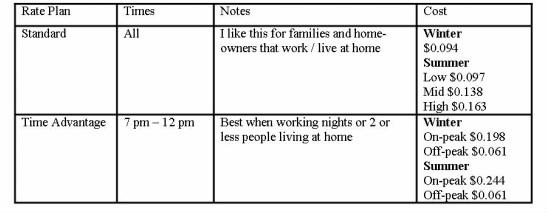
APS has several rate plans and depending on your schedule.  They are best suited for people that are regularly done for work Monday to Friday. 
Picture
http://www.aps.com/main/services/residential/rates/rates_29.html#standard

I thought APS had another 9 am – 6 pm rate plan, but as of this blog, I couldn’t find it on their website.  There is also the equalizer plan which many people like because of its predictability… except when it’s not predictable.  Under the Equalizer Plan you may the same amount on your bills each month as your usage is averaged over 9 to 12 months.  More information on the APS Equalizer Plan can be found below:

http://www.aps.com/main/services/residential/FAQ/ResFAQ_50.html

If you are interested in other energy efficiency ideas, take our quick quiz to the right sidebar and we’ll send you some insider DIY tips to save money on you bills.

Tuesday, May 10, 2011

Save Energy While on Vacation or Away for the Summer

A good number of the APS and SRP home energy audits I do are for eco-conscience snowbirds.  These residents typically reside in the Phoenix, Surprise and Scottsdale areas during the winter and go back north for the summer months.  Even though homeowners are only here for part of the year, many are still motivated to have the upgrades done because of comfort and air quality problems.  Other homeowners will have efficiency upgrades like duct sealing, air sealing and insulation work done because of the APS and SRP rebate program and to drive down energy costs.  During the homeowner interview, I am always interested to find out what each homeowner does to “summarize” their home.  For Phoenix’s permanent residents, the summer is a time many will take vacation for more temperate climates.  Either way presents opportunities listed below to save energy and money while away.
Tips for “Summerizing” Your Home While on Vacation
-          Turn the water heater off completely at the breaker or shut the gas line off.  At the least, set the dial to vacation mode to minimize stand by losses.
-          Turn the thermostat up to 90 degrees.  This will keep your home cool enough to not damage the structure or your belongings.
-          Fill gallons of water and place several throughout the house to add moisture over time.
-          Unplug energy vampire’s aka electronic devices.  TV’s will use more energy in stand by mode than when turned on.  Prevent wasteful spending by simply unplugging your electronics while away.
-           Keep window shades closed and sun screens on the exterior windows to minimize heat gain during the daytime.
For more tips on “summarizing” your home while away, visit here.